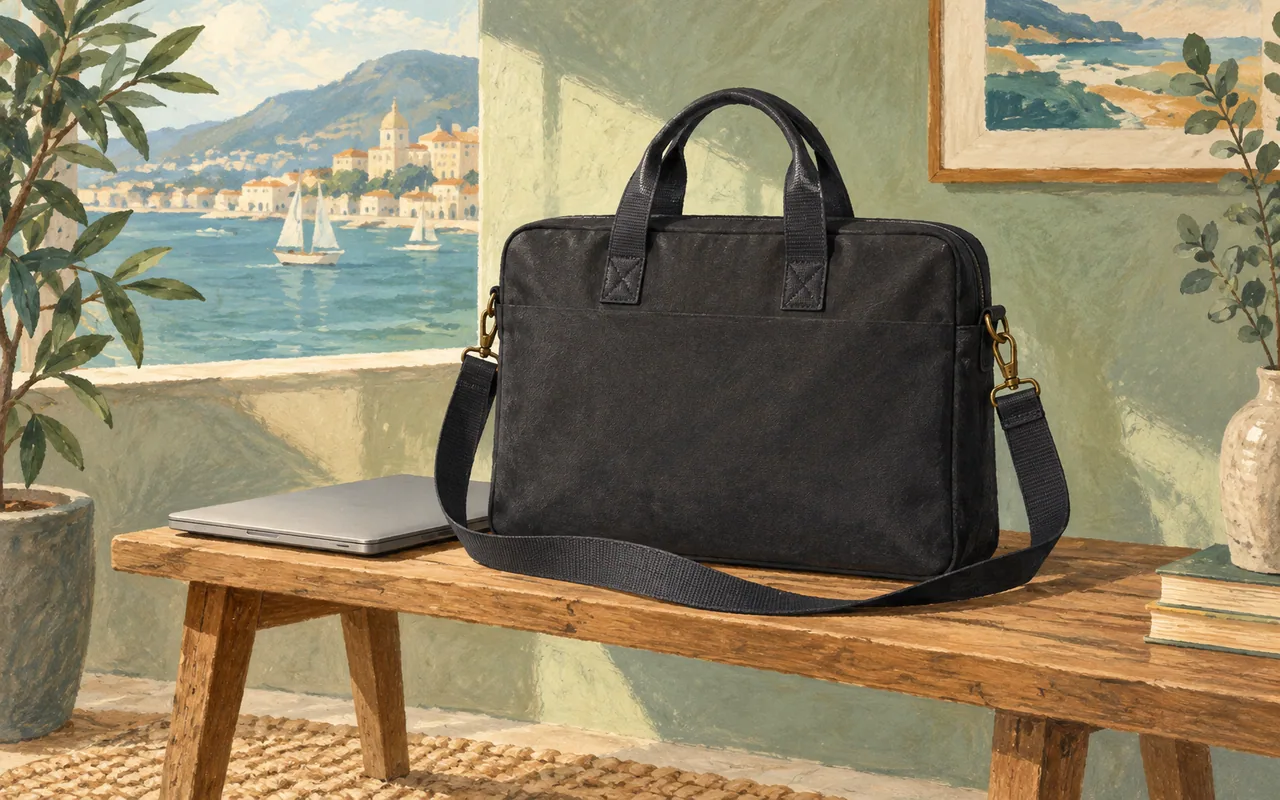
The Mobile Edge Eco-Friendly Briefcase has a clear appeal: a plain canvas work bag with a place for both a laptop and a tablet. I’d put it on a short list for a light office load. I’d be more cautious if the trip involves long walks, heavy books, or wet weather.
The key choice is fit. A screen size alone does not tell you whether a laptop will slide into a pocket. Nor does an “eco-friendly” name tell you how a bag was made or how it should be disposed of. Here is what matters before you buy.
The briefcase at a glance
| Detail | Manufacturer specification |
|---|---|
| Black model | MECBC1 |
| Outer fabric | Cotton canvas |
| Outside dimensions | 17.25 × 12.25 × 4.5 inches |
| Laptop pocket | 16 × 11.5 × 2 inches |
| Empty weight | 2.45 pounds |
| Listed US price | $59.99 |
The black Eco-Friendly Briefcase has padded laptop and tablet spaces, front zip pockets, a rear pocket, and an adjustable strap that comes off. Mobile Edge lists it for laptops with screens up to 16 inches. The case uses recycled plastic fittings.
Good points: Separate laptop and tablet pockets; removable shoulder strap; lifetime warranty.
Trade-offs: 2.45-pound empty weight; no verified waterproof rating; fit needs a tape measure.
Start with your laptop, not its screen size
Measure your closed laptop from side to side, front to back, and top to bottom. Include any hard shell you leave on. Compare those three figures with the pocket size in the table. Give yourself room to slide the device in without pulling hard on the zip.
A laptop sold as a 16-inch model may have a wider body than another with the same screen size. Large edges, hinges, and gaming hardware can change the fit. If a measurement is close, ask the maker or seller about your exact model before paying.
I would not buy a tight bag in the hope that canvas will stretch. Strain at a corner is a warning, not a good fit. A laptop should sit within the padded area, with the closure able to move freely.
Also decide whether you plan to use a separate sleeve. That adds thickness and width. Measure the whole bundle. It is easy to check the bare computer and then find that the sleeve makes the pocket too small.
What fits your workday?
Lay your daily gear on a table before choosing a case. Put the laptop, charger, tablet, notebook, keys, and cables in one group. Make a second group for things you carry only now and then. This makes it easier to see whether you need a slim work bag or space for a much larger load.
The briefcase’s separate pockets make sense when small pieces need a fixed home. I like the idea of keeping a charger apart from loose keys and work papers. It cuts down on the small hunt that happens when every item sits in one deep compartment.
Leave some space. A zip that closes only when you push hard on the bag is a sign to take things out. Packed pockets can press into the next compartment. The fact that you can force an item inside does not mean the bag carries it well.
Lunch and drinks are another question. I would keep a leak-prone meal away from electronics. For a few groceries after work, a compact bag from our reusable shopping bag guide can carry the extra load without stuffing food into the laptop case.
The empty weight deserves a thought
A bag can look slim and still make a noticeable share of the load. Add its weight to your actual laptop, charger, and other daily items. The total is the number you carry to the bus stop.
Try this at home with a scale. Weigh your usual gear together, then add the case’s listed empty weight. That small step is more useful than deciding from a photo that a bag looks light.
For a short walk between car and desk, a briefcase may be easy to live with. For a long commute on foot, think about how you handle a one-sided load. A different carrying style may suit you better. Comfort is personal, and the product page cannot settle it.
I’d also think about the trip back. Do you often add a book, a water bottle, or paperwork during the day? A bag chosen for the smallest morning load can feel cramped by evening.
What owners say, and what to take from it
Two verified-customer comments on Mobile Edge’s briefcase page praise the storage and build. One describes comfortable use over several weeks. Another describes stretching a very tight case around a larger laptop.
I take the first as one owner’s positive account. I would not follow the second approach. These are individual reports, not load tests or proof that an oversized device will be protected. Use the stated pocket measurements and seek an easy fit.
A small set of good reviews can help identify features to inspect. It cannot show how every zip, seam, or strap will hold up over years. When your bag arrives, check those parts while the seller’s return period still applies.
How much does “eco-friendly” tell you?
The canvas exterior and recycled fittings are concrete material details. They do not, by themselves, measure the whole bag’s effect on the environment. Farming, dyes, assembly, shipping, use, and disposal all sit outside a simple fabric label.
I would treat broad claims about a small footprint with care unless a clear product-level study backs them. The FTC’s Green Guides explain why sweeping environmental claims need strong support. A useful claim should tell you which part of the product it concerns.
Do not put the whole briefcase in a compost bin because it has a natural-fiber outer shell. A finished work bag contains several parts and materials. Cotton on the outside is not a composting instruction for the whole item.
The most useful green question may be simpler: will this bag let you keep carrying your gear for a long time? A good fit, repairable wear, and a style you will still want next year matter more to me than a leaf graphic on a label.
Read the material claim in full
Mobile Edge calls the exterior all-natural cotton canvas. That describes the shell, not every lining, pad, zip, or fitting. Recycled materials also need a clear scope. Do not assume the whole case is made from plastic bottles because other laptop bags use that fabric.
The company uses the phrase “minimal carbon footprint.” I would want a measured life-cycle comparison before treating that as proof of a lower impact than other cases. Sustainability claims should give you facts you can compare, including which parts they cover and how the result was measured.
The same care applies to packaging. A small box or a paper sleeve alone cannot tell you the whole impact of the product inside. It is worth keeping the focus on a bag that fits, stays useful, and helps protect the gear you own.
Warranty and care
Mobile Edge’s warranty FAQ says its carrying cases have lifetime cover for manufacturing defects for the original purchaser. This is not the same as insurance for every accident or for the laptop inside. Keep your receipt and check the full terms before you rely on the warranty.
If a seam or zip fails, contact the maker before throwing the case away. A photo, model number, and clear account of the fault can help. Do not take “lifetime” to mean that any wear will lead to a free replacement.
For cleaning, follow the bag’s care instructions or ask Mobile Edge. A padded case is more than a piece of plain canvas. I would not put it through a machine wash simply because some cotton shopping totes can be washed that way.
Check the quality when it arrives
Sort your gear into the pockets and close each zip without force. Look for loose stitching at the handle joins. Check that the strap clips feel secure and that the padding sits between your laptop and the outer wall. Keep the packaging until you have checked the fit and the seller’s return terms.
Then try the full load at home. A few minutes of handling cannot prove years of service, but it can show whether the shape works for you. If the case keeps swinging into your leg, or the strap feels wrong, address it while a return is still possible. That is a better use of money than hoping a poor fit will improve.
Check the base and handle joins now and then. Empty crumbs and grit from pockets. Let a damp case dry before storing it, and keep electronics out until it is dry. A briefcase should not serve as rain protection unless the maker gives a clear rating for that use.
Who should choose this briefcase?
I’d consider it for someone who carries one laptop, a tablet, and a tidy set of work items. The canvas look is casual enough for a café and plain enough for many offices. The separate spaces are the main reason to choose it.
I’d pass if the laptop is close to the pocket’s limits, if you need a verified waterproof case, or if an empty weight of more than two pounds feels too high. For frequent long walks, compare the total packed weight with a carrying style that suits your body.
My verdict: the Mobile Edge Eco-Friendly Briefcase is a sensible canvas work bag when fit and pocket layout match your day. Buy it for those useful details. The environmental name alone is not enough reason to replace a case you already like.