A laundry detergent needs to clean the clothes in your washer with a dose you can get right. A small pack or a green label is no help if you have to wash the same load twice.
These five eco-friendly clothes detergents take different routes: refill powder, film-free tablets, concentrated liquid, pods, and a familiar liquid jug. I’d start with the format that fits your routine, then look at the exact formula and pack. All five have an unscented or fragrance-free version.
Choose by format first
| Detergent | Why it may suit you |
|---|---|
| Meliora Unscented Powder | A dose you can adjust and a refill routine |
| Blueland Fragrance-Free Tablets | A fixed dose without a dissolving film |
| Dirty Labs Free & Clear | A small bottle of concentrated liquid |
| Dropps Sensitive Skin Unscented | Enzyme-free, premeasured pods |
| Seventh Generation Free & Clear | A liquid dose that can change with the load |
1. Meliora Unscented Laundry Powder: my refill pick
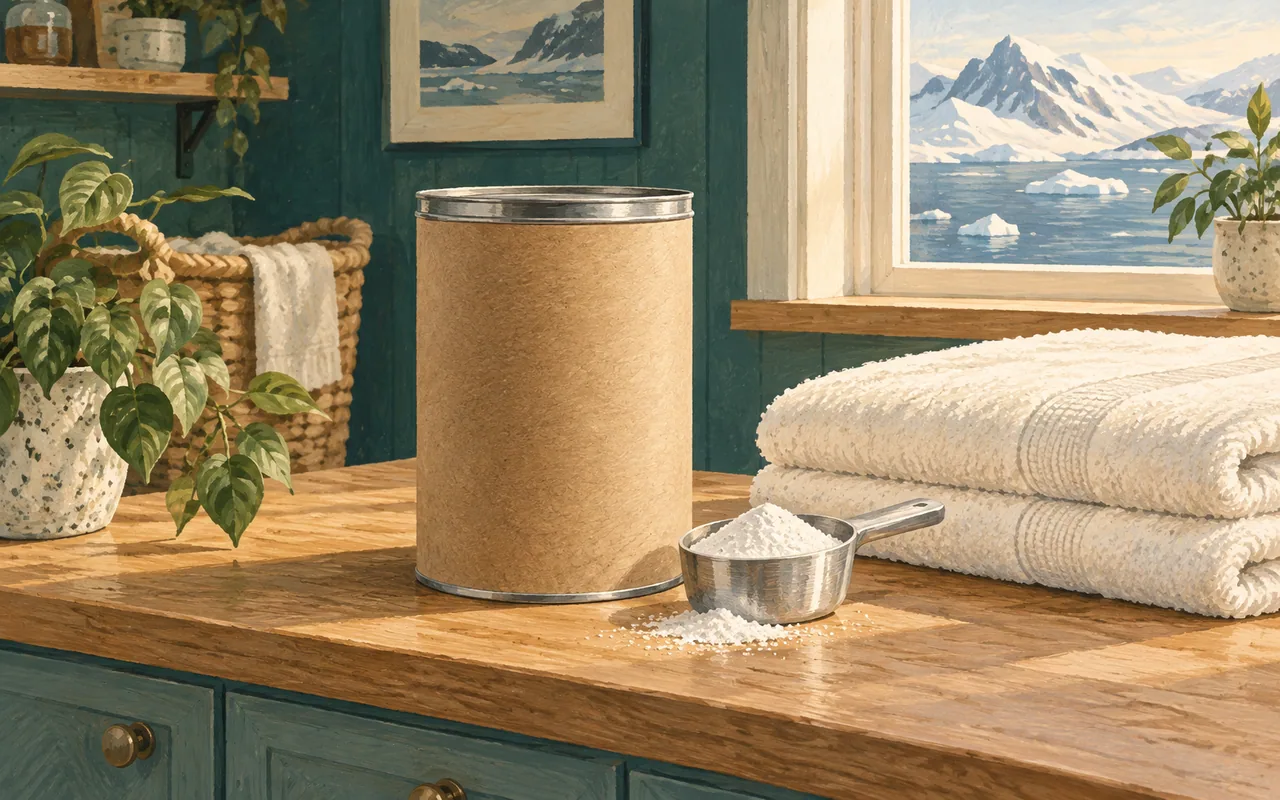
Meliora Laundry Powder comes in a paper-and-steel canister, with refill bags available. Choose Unscented to avoid added fragrance. The formula uses baking soda, washing soda, and vegetable soap.
The maker lists half a tablespoon for an HE load and one tablespoon for a standard machine. Its 35-ounce pack is rated for 128 HE loads or 64 standard loads. Those totals depend on using the stated dose.
I like a powder you can measure for the load. The trade-off is that you must measure it. Keep the scoop dry and follow the directions for putting it into the machine. Meliora also says this powder is not suited to graywater used on plants, so do not read a simple ingredient list as an outdoor-use claim.
Good points: Flexible dose; fragrance-free version.
Trade-offs: Needs careful measuring; not intended for plant graywater use.
2. Blueland Tablets: skip the scoop
Blueland’s Fragrance-Free Laundry Detergent Tablets have no dissolving plastic-film wrapper. The directions call for a tablet in the drum before clothes, with more for a large load. Keep them in their dry, closed storage container.
I’d consider tablets for a shared laundry room or a routine where a measured unit is easier than a scoop. The fixed size is less flexible for tiny loads. Do not assume one tablet suits every amount of laundry.
Check the drum and clothes after the first few washes. If a tablet leaves bits behind, check its placement and whether the load had room to move. Blueland has changed its formula, so make sure any instructions you follow match the pack you have.
Good points: No measuring scoop; no PVA wrapper.
Trade-offs: Fixed dose; dissolving depends on correct use.
3. Dirty Labs Free & Clear: concentrated liquid
Dirty Labs Free & Clear Bio Enzyme Laundry Detergent is a fragrance-free liquid in an aluminum bottle. The small 8.6-fluid-ounce size is listed for 32 loads. A larger refill size is also sold.
This would be my liquid choice when shelf space is tight. A small bottle can be easier to carry to a shared washer. The flip side is the small dose: use the measuring beaker and directions, not a casual pour.
The formula has enzymes, which help break down types of soil. That does not make it right for every fiber. Check the garment label, especially for wool and silk, and use a suitable cleaner for those items.
Good points: Small bottle; enzyme formula.
Trade-offs: Small dose takes care; not a universal choice for delicate fibers.
4. Dropps Sensitive Skin: an enzyme-free pod
Dropps Sensitive Skin Unscented Laundry Detergent Pods have no added fragrance or dyes and use an enzyme-free formula. This is a different formula from the brand’s Free + Clear range. Check the exact name on the box.
I’d consider it when you want a premeasured pod and have a reason to avoid enzymes. It is not proof that no one can react to it. The ingredient list still matters.
The pods use dissolving film and come in paperboard packaging. Dissolving in a wash is not the same claim as complete breakdown in every setting. Keep the pods sealed, dry, and well away from children and pets. Follow the box for dose and placement.
Good points: Premeasured; enzyme-free formula.
Trade-offs: Fixed dose; uses dissolving film.
5. Seventh Generation Free & Clear: a familiar liquid
Seventh Generation Free & Clear Liquid Laundry Detergent has no added fragrance or dyes. The maker lists it for HE and standard washers and for cold, warm, or hot water. It is sold in several jug sizes.
I’d choose this format if I wanted to vary a liquid dose without changing the rest of the routine. Read the cap marks in good light. A full cap is not automatically the right dose.
The trade-off is the plastic jug. Check your local recycling rules and follow their instructions for empty containers. A plant-based ingredient claim does not describe the whole pack or make the product safe to pour into a stream.
Good points: Adjustable dose; cold-water use.
Trade-offs: Plastic jug; cap needs careful measuring.
What makes a laundry detergent eco-friendly?
There is no single feature that answers the whole question. Ingredients, dose, packaging, shipping, wash temperature, and wastewater all play a part. I’d look for a precise claim before a broad one.
A useful mark to understand is EPA Safer Choice. Its standard looks at ingredients and other product requirements, including performance and packaging. Check the exact product and current label. A brand may sell several formulas with different status.
Meliora lists its laundry powder as Leaping Bunny certified. That is an animal-testing standard. It does not rate stain removal or prove a lower total environmental impact. Match each certification to the specific question it answers.
“Natural” does not mean harmless. “Plant-based” says something about where ingredients came from, but not everything about their effect. A fragrance-free product may be the simpler choice for someone who wants no added scent, yet it is not a promise against all skin reactions.
I would also avoid using the number of ingredients as a cleaning score. A short list can be easy to understand. A more complex formula may serve a useful job on a particular stain. Pick for your needs and judge the actual wash.
Is natural laundry detergent always the better choice?
No. “Natural laundry detergent” does not tell you how well a formula cleans or how it affects the environment. Plant-based ingredients and mineral-based ingredients can have useful roles, but their source alone does not give you a full answer.
Soap can be made from an oil, such as coconut oil. Other cleaners use plant-based surfactants, which help lift and carry away soil. Those are details to understand, not a reason to assume that one whole class of laundry products is good and all conventional detergents are bad.
What about a non-toxic laundry detergent claim?
The FTC’s guidance on green claims is a useful check on broad promises. Claims about being non-toxic need support. Ask what the claim covers, how it was assessed, and how the product must be used.
I would not sort every bottle into a simple “toxic laundry detergent” or harmless category based on its front label. Terms such as “harsh chemicals” or “green formula” do not replace a full ingredient list. Safe storage and the stated dose still matter for a non-toxic laundry detergent.
Added scent is a separate choice
Artificial fragrances, essential oils, and other scent ingredients can all make a wash smell different. A subtle scent may be pleasant to one person and unwelcome to another. Fragrance-free is the clearest starting point if your aim is to avoid added perfume.
Do not judge cleaning power by whether laundry smells fresh. A strong scent can linger on clothes that still have soil in them. If skin irritation starts after a change in detergent, stop using the new product and seek medical advice if it persists. Keep the packaging so the ingredients are easy to check.
Use less guesswork, not less than the label says
Check the dose for your load size, soil level, and water hardness. More detergent is not an automatic route to cleaner clothes. Too little can also leave a load poorly washed. Start with the product directions and your washer’s manual.
Do not copy a capful from one brand to another. A concentrated liquid may need a much smaller amount. Powder scoops also vary. Keep the proper measure with the right pack.
For pods and tablets, place them where the maker says, at the stage it says. Leave enough room for the clothes to move. If a product leaves visible bits, do not keep adding more. Check the placement, load size, cycle, and maker’s help page.
Keep every cleaner in its labeled pack or intended labeled refill container. Do not store detergent in a food jar. Even a plain white tablet can be harmful if a child mistakes it for something to eat.
Powder, laundry soap, or liquid detergent?
Choose a liquid detergent if you value easy measuring for different loads. Choose laundry powder if you prefer a dry format and can keep the measure dry. Laundry soap is one type of cleaning ingredient; the word “soap” alone does not tell you whether the full product suits your washer.
Look for the machine type on the pack. An HE washer needs a suitable formula. Never assume that a homemade mix or a cleaner meant for hand washing will behave like an HE laundry detergent. Follow the washer manual when it gives specific limits.
What about laundry detergent sheets?
Laundry detergent sheets are another premeasured format. Laundry sheets may pack flat, but shape alone does not show their cleaning power, ingredients, or full packaging impact. Read the formula and dose before treating a sheet as a zero-waste answer.
This list focuses on powders, tablets, pods, and liquids. If you already have a sheet that cleans your everyday loads well, there is no need to discard it just to try one of these picks. Compare the wash you get and the amount you use.
Do you need fabric softener too?
A detergent and a fabric softener serve different jobs. Do not add softener just because it is sold beside your detergent. Check whether the fabric allows it and whether it solves a problem you actually have.
The same rule applies to scent boosters and other laundry products. Start with the cleaner your clothes need. Adding more bottles can add cost and clutter without making your routine better. Keep chlorine bleach and other additives separate, and never mix cleaning products outside their label directions.
A cold wash can be a useful change
For many routine loads, cold water is a good starting point when the fabric and detergent allow it. ENERGY STAR’s washer guidance notes that cold water generally cleans well except for situations such as oily stains. Heating less water can reduce the energy used.
Follow garment care labels and any hygiene needs for the load. Do not use a general cold-wash tip to replace specific instructions for illness, heavy soil, or a fabric that needs other care.
Wash a full load within the machine’s limit. “Full” does not mean packed tight. There needs to be room for the wash to do its job. Air dry when it suits the fabric and the space you have.
Give tough stains a separate plan
For stubborn stains, read both the garment label and the detergent directions before doing anything. Some liquid detergents can be used for a pre-treatment; others call for a separate stain remover. Use only the method allowed for that product and fabric.
A few drops of a suitable liquid on one mark may be more useful than extra cleaner across a whole load, but the label must allow that use. Check the spot before heat drying. If the stain is still there, decide on the next step while the fabric is still easy to inspect.
Do not expect odor-fighting power from scent alone. Let used towels and gym clothes dry before leaving them in a closed hamper. Keep the washer clean as its manual directs. A musty machine can make it hard to judge the detergent fairly.
Cold water is a tool, not a rule for every load
Use warm water or hot water when the care and hygiene needs call for it. Eco-friendly detergents do not all share one formula or one ideal cycle. Water temperature, time, movement, and the cleaner work together.
I’d keep a simple note after trying a new detergent: which cycle, how much cleaner, and whether the load came out clean. One clear change at a time helps show what works. It beats changing the product, dose, and cycle all at once.
Choose a pack you will use well
Powder and tablets can avoid shipping a large amount of water. Concentrated liquid can reduce bottle size. Refill packs can let you keep a container for longer. These are useful features, but none should stand in for a whole-life comparison.
Buy a small amount first if the formula is new to you. A large bulk order saves little if it does not suit your washer. Check the price for the number of doses you actually use, including shipping or a subscription you would need to keep.
Our shopping bag guide can help with carrying the groceries home. Wash only bags whose care labels allow it. The same care-first rule applies to the towels and clothes you bring back from a day out with mineral sunscreen.
Plastic-free packaging needs a full check
Look at the lid, liner, seal, and refill pack as well as the main box. Cardboard packaging may have other layers. A paper-looking pack is not enough to prove a plastic-free packaging claim, and a plastic-free pack does not mean the detergent has no polymer ingredients.
Read any compostable packaging instructions carefully. Home and industrial composting are different routes. If your local service does not accept the pack, its claim may be of little use where you live. Keep recycling advice tied to the actual material and local collection.
What is the film around a laundry pod?
Many laundry pods use a water-soluble film made with polyvinyl alcohol, often shortened to PVA or PVOH. The film lets a measured dose reach the wash. Seeing it dissolve does not tell you every step of what happens to it after the water leaves your machine.
If you want to avoid a film wrapper, a loose powder or film-free tablet gives you a direct choice. That is clearer than assuming all pods have the same footprint or that a dissolving film makes a product fully plastic-free.
Can eco-friendly detergent go into outdoor water?
Do not pour detergent or wash water into a stream, lake, or sea. A product meant for a washing machine is used with a wastewater system. A claim about biodegradable ingredients does not make direct release harmless to aquatic life.
“Septic safe” and “safe for garden graywater” are different questions. Check your system’s instructions and the exact product guidance. Meliora’s graywater limit is a good example of why the word “eco” cannot answer every use case.
Make laundry day simpler
Keep one everyday detergent that works. Store its measure with it, and use a separate suitable product only when a fabric needs one. Many eco-friendly detergents offer useful changes to dose or plastic packaging, but buying several at once makes them harder to compare.
For me, the best eco-friendly laundry routine is easy to repeat: wash clothes when they need it, fill the machine sensibly, use the right dose, and keep garments in use. Cutting a bit of single-use plastic is welcome. Avoiding wasted cleaner and repeat washes belongs in the same decision.
My pick depends on the routine
I’d choose Meliora Unscented Powder for a measured refill routine, Blueland for film-free tablets, or Dirty Labs for a small liquid bottle. Dropps makes sense when an enzyme-free pod suits your needs. Seventh Generation offers a familiar liquid format with a dose you can change.
Keep the cleaner that works if you already use it well. When you need a new one, choose the exact formula, measure the dose, and give it a fair trial. The best change is one you can keep doing each wash.